
Utah News Dispatch
Tech companies sue Utah over age verification law for app stores


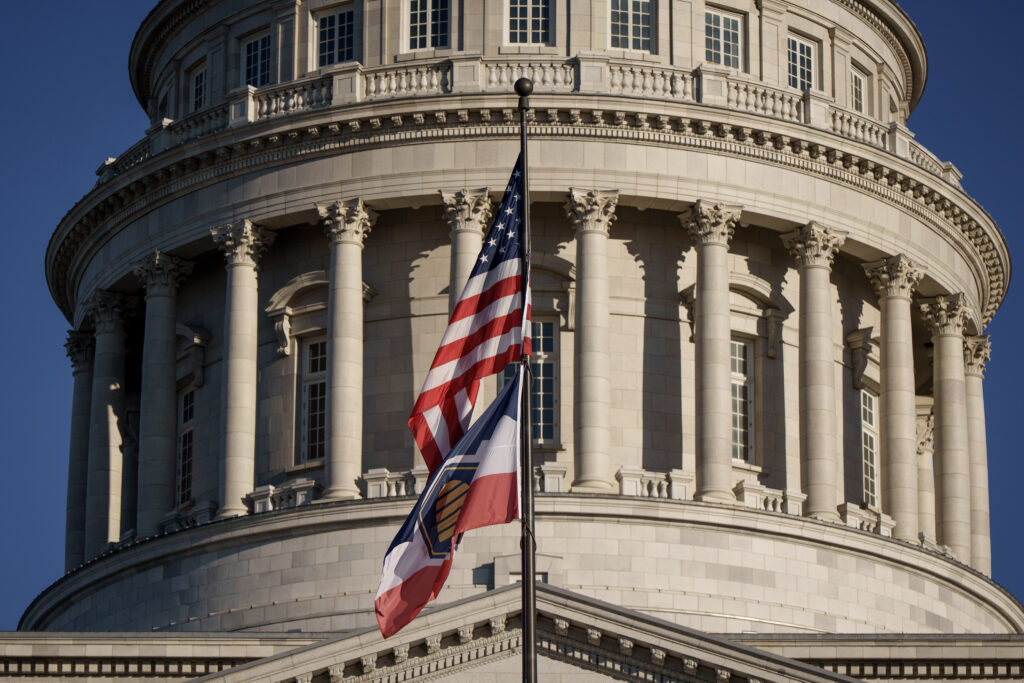


The Capitol in Salt Lake City is pictured on the first day of the legislative session, Tuesday, Jan. 20, 2026. (Photo by Spenser Heaps for Utah News Dispatch)
A 2025 Utah law requiring app stores to verify users’ ages is being challenged in court by a communications and technology trade association claiming the law is unconstitutional. It’s a move that was anticipated when the law was first proposed in the Utah Legislature.
The Computer & Communications Industry Association sued Utah Attorney General Derek Brown and the director of the Utah Division of Consumer Protection in federal court to block the law that Woods Cross Republican Sen. Todd Weiler sponsored last general session mandating that app stores get parental consent before approving app and in-app purchases from minors’ accounts. The association described the legislation as “a violation of the First Amendment.”
The lawsuit criticizes that the law extends to all apps, including e-books, email and entertainment.
SUBSCRIBE: GET THE MORNING HEADLINES DELIVERED TO YOUR INBOX
“Our Constitution forbids laws that require businesses to ‘card’ people before they can enter bookstores and community theaters. And the First Amendment prohibits such oppressive laws as much in cyberspace as it does in the physical world,” the lawsuit says.
Lawmakers advance bill requiring age verification for app store purchases
The law is just too broad, the association argued. There are already safety tools available to parents to help them control what their children access on their mobile devices, the lawsuit says, which preserves parental choice “‘without burdening access to protected expression for everyone.”
The tech group is also challenging the state’s mandate on app developers to rate the age appropriateness of their apps “according to Utah’s vague and unworkable set of age categories.”
“When a state erects a barrier to the vast library of online speech unless the speaker jumps through a series of age-gating hoops, it must receive exacting constitutional scrutiny,” said Stephanie Joyce, senior vice president at the Computer & Communications Industry Association. “Under well-settled precedent, that scrutiny warrants judicial intervention to ensure that adults and young people can continue to access the lawful online speech of their choice.”
The Utah Attorney General’s Office said in a prepared statement that it “will vigorously defend state law against legal challenges.”
When presenting his bill last year, Weiler characterized it as a law regulating contracts, not content. Terms and conditions are binding contracts that, say, a 9-year-old may be entering, he argued in a Senate Transportation, Public Utilities, Energy, and Technology Committee meeting at the time.
The bill ended up passing with little opposition in both bodies. And this year, Taylorsville Republican Rep. Jim Dunnigan — who also co-sponsored Weiler’s bill in 2025 — is running legislation to make some exceptions for apps that allow subaccounts or profiles. But the bill hasn’t been discussed yet.
Utah House Speaker Mike Schultz told reporters on Thursday he thinks age verification made sense, and he believes the state will prevail in this lawsuit.
“I’m disappointed, honestly, in the social media companies, technology companies, that they’re actually actively, in many cases, trying to get kids addicted to apps and to their platforms,” Schultz said.