
Utah News Dispatch
Nationwide immigration raids bring fear to Latinos in Utah, but a glimmer of hope prevails


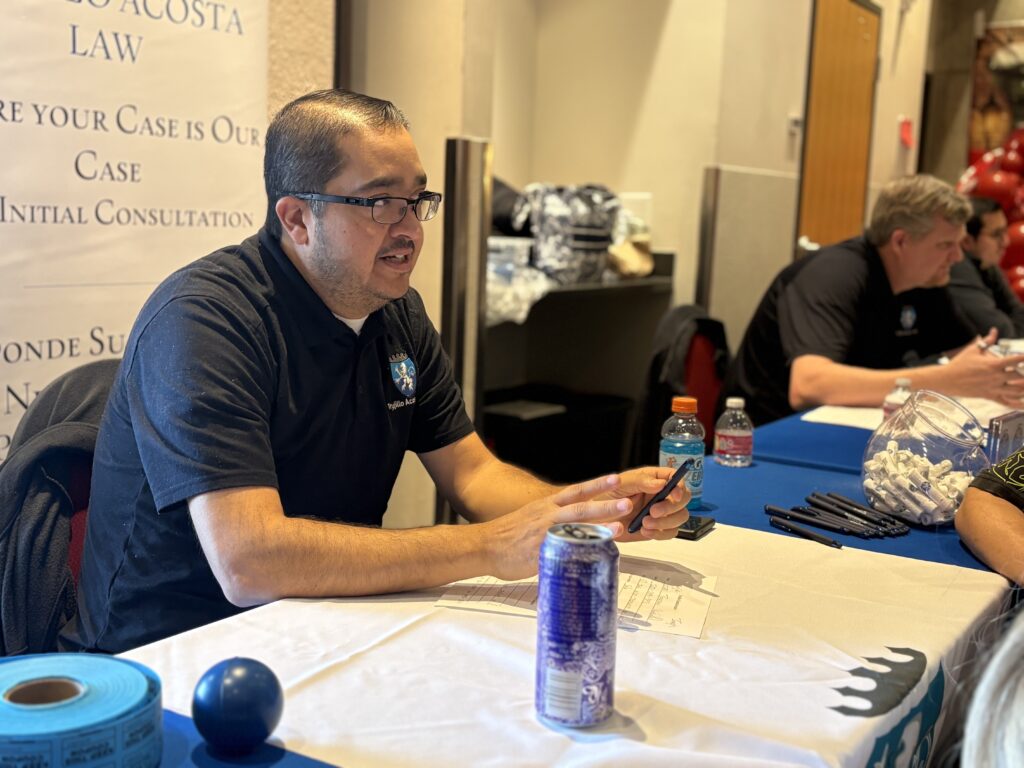


Immigration attorney Carlos Trujillo speaks with a client during Utahzolanos’ Christmas celebration on Dec. 6, 2025. (Annie Knox/Utah News Dispatch)
On an early December weekend hundreds of Latinos congregated at a Salt Lake Community College conference center in Sandy. Tables were set in a fair-like style, the smell of a mixture of perfume samples saturated the air, the hot pink and bright yellow of Venezuelan snack packaging and stress balls from an immigration law firm decorated some areas.
A voice with a Maracaibo accent announced an upcoming raffle for a piece of pernil-style pork, a traditional Christmas dish every hour, this year’s initiative at the annual Christmas celebration hosted by Utahzolanos, a social media outlet and community.
The event has been a tradition kept for five years. But this time, amid stronger immigration enforcement tactics deployed by the Trump administration, and increasing immigration arrests in the state, the sentiment and tone around the event changed.
SUBSCRIBE: GET THE MORNING HEADLINES DELIVERED TO YOUR INBOX
Organizers modeled the party into an event in support of the community, said Patricia Quiñonez, who runs Utahzolanos. However, she said, it still was “a chance to cheer each other on, to give each other strength.”
Fewer people showed up this year, Quiñonez said. Still, about 2,000 came, which is about 1,000 less than what the organization had seen in past years.
“We are happy because we expected fear to prevail over the call, the invitation to attend,” she said.
This year’s Christmas party had Santa Claus hats, toys, crafts and gifts. However, the busiest tables were those of immigration law firms offering free consultations.
But, other events, like Utahzolanos’ New Year’s party, an often-sold out event where over 1,000 people gather for food and music, was almost canceled as ticket sales languished. The traditional celebration ultimately came together, but with 60% fewer attendees this year.
“We didn’t want to lose the tradition we’ve had for the past five years,” she said. “The families who didn’t come told us they were afraid to attend a predominantly Latino event that might attract the attention of ICE.”
Venezuelans living in the U.S. have felt a particularly heavy impact since the second Trump administration took power. The Temporary Protection Status, a protection from deportation that Trump granted Venezuelans during his first term, has been eliminated, abruptly leaving about 600,000 Venezuelans without work permits, driver’s licenses or permission to remain in the country. In all, more than 1.5 million people lost legal status in 2025.
Quiñonez says many of her group’s followers have said they are self-deporting out of fear of being detained and separated from their families. Others have voluntarily left the country after the detention of the breadwinner.
“It’s not just people who have been here for two, or three years. We are talking about friends who applied for asylum 10, eight, seven years ago,” Quiñonez said in Spanish, adding that many feel worn out by how cases are playing out in immigration courts.
In October, the Department of Homeland Security reported that 1.6 million people had voluntarily self-deported since President Donald Trump reclaimed the White House.
“Fear is overcoming faith or the choice of moving forward with immigration cases,” she said.
Since Venezuela and the U.S. don’t share a diplomatic relation, first-generation Americans born in Venezuelan families aren’t able to receive a visa to Venezuela to join their parents if they are deported.
Some of those who decide to stay have begun limiting their routines — Latin restaurants have become off-limits for many fearing an ICE raid. And some churches have low attendance on Sundays, as well, she said. Immigration attorneys have started advising their clients to restrict travel, a new recommendation stemming from a high-profile ICE arrest at the Salt Lake City airport.
However, in the last three months, Quiñonez has also seen Latino entrepreneurs opening businesses, including restaurants, barber shops, insurance companies and car dealerships, she said.
But, amid these sparks of hope in the Latin community, immigrants remain uncertain about whether immigration enforcement will turn more aggressive in Utah, especially now with reports naming Utah the home of an upcoming 10,000-bed ICE detention facility.
“It makes you wonder, if that 10,000-people capacity means that they’ll be stricter. Will they search for more people to be at that detention center?” Quiñonez said.
‘The fear isn’t exclusively quarantined just to Latinos’
Like other owners of establishments with international offerings, for a naturalized American business owner with warehouse operations in Salt Lake City, watching how ICE raids developed in 2025 makes him feel “completely uncomfortable.”
While the business owner is an American citizen, with tensions lingering in the immigrant community, he asked not to be identified for fear of becoming an ICE target.
“Their program is to remove criminals from our communities, but our community is suffering because they don’t pause and take the time to respect human rights,” he said, adding that officers have often detained people without a criminal record. “It’s terrible for our communities, and it’s terrible for any industries where immigrants and minorities are working.”
Anecdotally, there hasn’t been a massive mobilization across Hispanic businesses in the state, said Victoria Petro, a Salt Lake City Council member and executive director of the Utah Hispanic Chamber of Commerce. But, this federal administration’s tactics instill fear among communities in the state.
“People are more susceptible to false alarms and anecdotes, right?” Petro said. “So it just creates kind of a jumpiness and a difficulty for our people to understand, where is truth? Where is credible information?”
The immigration enforcement operations have also brought a chilling effect to Utah Hispanic establishments — mostly from anxiety about spending money in Latin businesses in fear of being detained, even with a legal immigration status, she said.
“If I’m a consumer, and I go to a market that caters predominantly to the Hispanic community, ‘la migra’ might show up there a lot more readily than they’re going to show up at Smith’s,” Petro said. “So we’re seeing a transfer of buying power to a more dominant paradigm, and it’s more difficult to aggregate audiences and consumers in places where they worry they might be profiled.”
With more Latin consumers saving up for emergencies and avoiding Hispanic establishments, the conversation around immigration enforcement in the chamber has been ongoing, Petro said, with many businesses aiming to determine how to maintain consumer bases with this threat.
“I was just with a business the other day that showed me their year-over-year, their expenses have skyrocketed and their revenues have gone down,” she said.
And, not only Hispanic-owned businesses have suffered the impact of the federal operations.
“We’ve seen an influx from construction companies who are looking into membership with us to stand with us, and to try to stay up to date as to what they’re facing in labor supply,” Petro said, “So the fear isn’t exclusively quarantined just to Latinos. It’s being shared now by the dominant paradigm as well.”
The Salt Lake City business owner still hopes his staff doesn’t feel targeted just for the fact his business has Mexican origins. He has done some planning, ensuring that everyone knows their rights in the case an immigration officer comes knocking on his business’ door. But, he’s not making a big fuss out of it, especially since not every employee that works for him “happens to be Mexican,” he said.
His job, he said, is to run his business, “not to create chaos.”