
Utah News Dispatch
Lawmakers propose bell-to-bell cellphone ban in Utah schools with big support from Cox


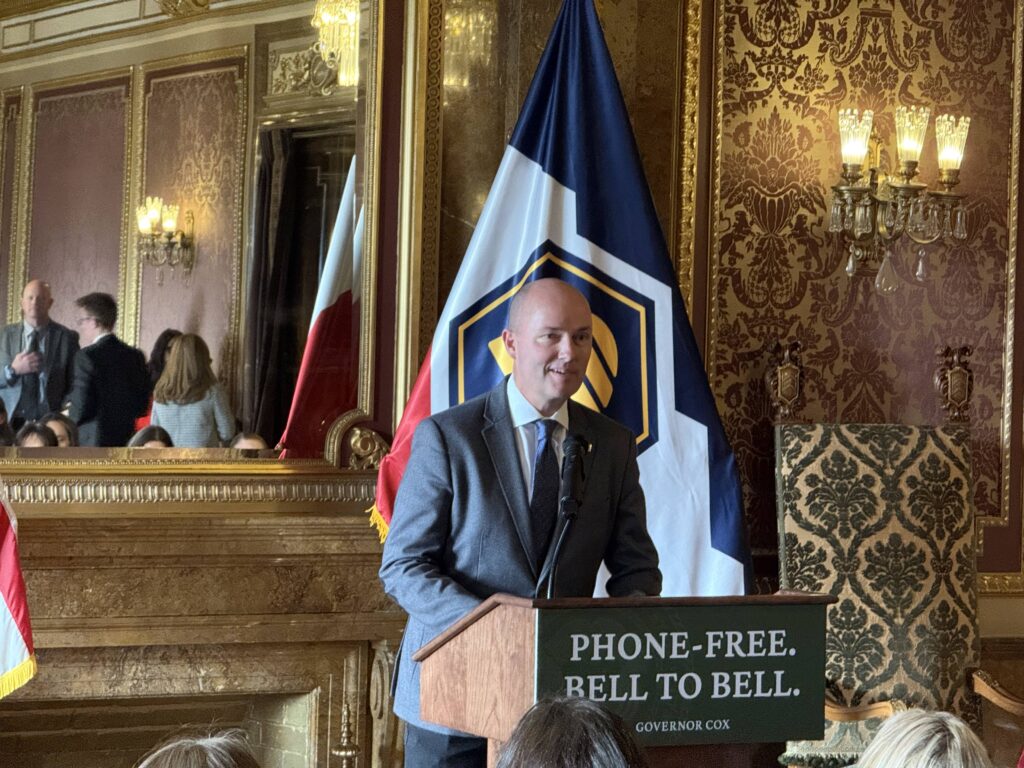


Utah Gov. Spencer Cox speaks during a news conference introducing a bell-to-bell cellphone ban in public schools on Jan. 7, 2026. (Alixel Cabrera/Utah News Dispatch)
Last fall Utah students had a taste of a statewide cellphone ban during classroom hours. But, the law that an overwhelming majority of the Legislature voted to pass last year doesn’t go far enough, Gov. Spencer Cox said.
That effort, he said, won’t be finished until smart devices are prohibited during the whole school day, including lunch periods, transition times between classes, and recess. So, when the Utah Legislature convenes on Jan. 20, South Jordan Republican Sen. Lincoln Fillmore will be taking another look at the cellphone ban bill he passed last year and incorporating Cox’s feedback.
“We have an opportunity to fix what we got wrong last time and do it the right way this time. I am convinced more than ever that a bell-to-bell cellphone ban is the single most important thing that we can do for our students in our schools today,” Cox said during a news conference promoting Fillmore’s new bill on Wednesday.
SUBSCRIBE: GET THE MORNING HEADLINES DELIVERED TO YOUR INBOX
Under the current law, public schools in Utah have a default cellphone ban policy for students during class time. However, administrators have the power to implement rules that can be either more flexible or stricter for devices. That’s something that Fillmore’s 2026 bill won’t change.
“I am not aware of a single school district, even though they have the power to do so, who have gone less than what the state law requires them to do,” Fillmore said. “But I am aware of a lot of individual schools and school districts who have stepped farther.”
Some schools already have a bell-to-bell cellphone ban, including Granger High in West Valley City, which established the rule in 2024. According to Cox, a principal in one of those schools reported higher attendance rates, better test scores and fewer bullying incidents.
Cox applauds bills taking aim at ‘destructive’ apps and cellphones
It is up to schools to provide storage solutions for phones, Fillmore said. Some have invested in magnetic locking pouches, while others have required students to simply keep their devices in their backpacks.
“There are all kinds of workable solutions here at various costs, and I think it’s appropriate to let those decisions be made at the local school district,” he said.
For Cox, who has campaigned to reduce social media usage and increase regulations on tech companies, this is “an easy call,” he said. Especially with the rise of artificial intelligence.
“If we thought it wasn’t a fair fight with the social media companies, the fight is going to completely overwhelm us with AI chatbots and their ability to not just rewire our brains, but hijack everything that makes us human,” he said. “And we can’t allow that to happen in our schools.”
Describing devices and social media as addictive, Cox added that it is a mistake to not understand “the destructive power of these devices.” School cellphone policies, he added, are tied to the conservative principle to collectively protect children “against these harms that are debasing them.”
Avery Gonzales, who advocated for the 2025 law during her senior year in Cache County, was also at the news conference with representatives from The Policy Project, a nonprofit in the state that has backed the cellphone ban effort.
While Gonzales remembers her peers being upset at her for standing by the rule, she said many had a change of heart when they realized the effects their phones had on their connections with classmates.
“Instead of scrolling alone, they are talking, laughing and finally building real friendships,” she said. “A bell-to-bell approach would strengthen the positive results we are already seeing today. This approach creates consistency and clarity. It allows students to fully disconnect from their screens and fully reconnect with learning and with each other.”