
Utah News Dispatch
Is Utah’s new 3-judge panel unconstitutional? Utah Supreme Court hears arguments


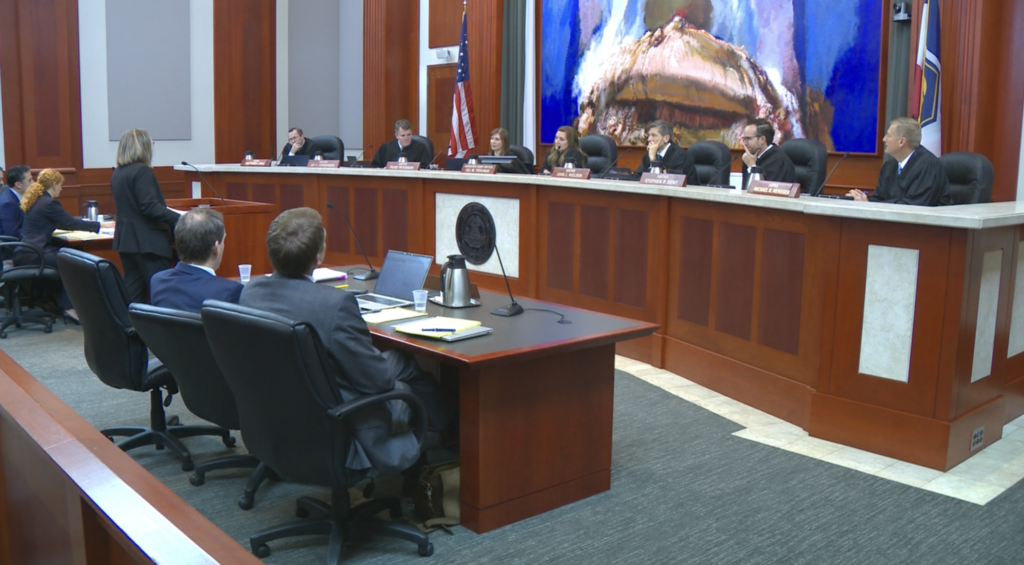


The newly expanded seven-member Utah Supreme Court hears arguments over whether a lawsuit over fossil fuel development should be transferred to a new three-judge panel in a hearing at the Utah Supreme Court’s chambers in Salt Lake City on Oct. 5, 2026. (Pool photo by Julian Conrads/FOX 13 News)
The Utah Supreme Court heard three back-to-back cases on Monday asking the high court to block a transfer of the cases to the Utah Legislature’s newly created, randomly selected three-judge panel specifically meant to hear challenges to Utah laws.
Attorneys in the three lawsuits — Planned Parenthood’s challenge to the state’s near-total abortion ban, the League of Women Voters’ of Utah’s anti-gerrymandering case, and young Utahns suing the state over harms caused by fossil fuel permits — argued the Republican-controlled Utah Legislature overstepped its constitutional authority when it created the three-judge panel earlier this year.
Faced with more lawsuits, Utah lawmakers move to change their new ‘constitutional court’
Proponents of the new panel made up of three district court judges have argued it’s meant to prevent “forum shopping” — or filing lawsuits in specific courts in order to receive a favorable outcome — and increasing the number of judges that would consider high-stakes cases that challenge the constitutionality of state laws.
However, critics have alleged that the three-judge panel is unconstitutional, arguing the Utah Constitution doesn’t grant the Legislature the authority to create a district court structure that’s made up of more than one judge — and that it violates separation of powers between the courts and the Legislature.
The plaintiffs in the three cases also argue the new court structure has delayed ongoing district court proceedings in each of their cases while allowing state officials to move cases away from judges that haven’t given them favorable outcomes.
The trio of hearings marked the first high-profile cases to come before the newly expanded seven-member Utah Supreme Court, and they are among the first to spotlight how the court’s four newly appointed justices operate from the bench.
Utah Supreme Court justice recused from 2 cases challenging constitutionality of new 3-judge panel
Two of them — Justices Jay Jorgensen and Stephen Dent, who have not held judicial positions prior to their appointments — jumped right into the fray, quick to start grilling attorneys.
Justice John Nielsen recused himself from two of the hearings (the abortion and redistricting cases) due to past work he did as a private attorney for Pro-Life Utah in 2022 and the Utah Republican Party in a prior appeal to the underlying anti-gerrymandering lawsuit.
For the Planned Parenthood and redistricting case hearings, 2nd District Judge Joseph Bean was appointed to fill in for Nielsen, though Nielsen sat on the bench for the case over fossil fuel development.
Monday’s hearings stretched hours, well into the afternoon, with no decisions made. The court took the matter under advisement and is scheduled to recess until November. The justices gave no indication of when they might issue a decision in any of the cases.
Planned Parenthood
Planned Parenthood Association of Utah’s attorney, Camila Vega, started her opening argument by saying the Legislature’s creation of the three-judge court came as the lawsuit over Utah’s near-total abortion ban neared its finish line, changing the rules of the game at the eleventh hour.
“After four years of litigation and sitting inches from the finish line, PPAU’s case has been disrupted by legislation threatening to overhaul the structure of Utah’s judiciary,” Vega said.


Currently an injunction continues to block Utah’s near-total ban, upheld by the Utah Supreme Court in 2024 — one of the rulings that year that infuriated Utah’s GOP lawmakers. Today, abortion remains legal in Utah up to 18 weeks gestation.
Frustrated with that case and how long it has taken to wind its way through the courts, the abortion lawsuit was one of the first state officials moved to transfer to the three-judge panel soon after the Legislature created it earlier this year.
“This case and the two others this morning raise important questions,” Vega said. “Can the Legislature create a new type of district court without the express, constitutional authority to do so? Can it make this court available only at a party’s election and only for certain cases, including those against state defendants, like the Legislature itself? And can it do all of this in the name of solving problems that simply do not exist?”
Utah governor swiftly signs bill to create 3-judge ‘constitutional court’ to hear challenges to laws
It was that moment — less than a minute into Vega’s opening argument — that Jorgensen started grilling her.
“Who are we to tell the Legislature what problems exist in society?” Jorgensen interjected.
Vega answered by saying lawmakers, in making recent changes to the judiciary, have pointed to “problems like solving judicial trust, efficiency … these are serious accusations, and there is really no evidence of any existence of these problems.”
“There’s no evidence with us,” Jorgensen said. “But that’s why courts on all topics really defer to the Legislature. They talk to people out in the community … they get stopped in the grocery store. We talk to nobody. Somebody stops me in the grocery store, I won’t talk to them because we can only consider what’s in the record.”
Vega argued that what the “record reflects, your Honor, is not that there is distrust in the judiciary but there is disagreement with certain judicial decisions.” She argued the creation of the three-judge panel is an “improper legislative purpose.”
Dent also pressed Vega on her assertion that the Legislature doesn’t have the “express” constitutional power to create a three-judge district court panel.
“One of our core principals is that the state constitution is not a grant of power, but a limitation of power,” Dent said. “So why should we be looking for express grants of power, and how does your position square with that fundamental principle?”


Vega argued that Article VIII of the Utah Constitution, which outlines the state’s judicial department, “lays out a very careful balance” and “contains numerous express provisions of authority to the Legislature for the ways that it can shape the judiciary” through lawmaking. Those provisions set parameters, she argued, and don’t grant the Legislature “plenary authority over the judiciary.”
Justice Paige Petersen also raised questions, while pointing out the law and resolutions that created the three-judge panel are “unusual” in the sense that, when invoked, they immediately take cases away from the original district court judge without allowing that district court to rule on whether transfer is proper.
“So there’s no way for a plaintiff to challenge the transfer or to avoid the transfer happening,” Petersen said, questioning whether that creates a separation of powers issue.
Petersen also noted she’s heard complaints about the abortion case and that it’s “taking too much time,” but she pointed out Planned Parenthood of Utah and the state’s attorneys agreed on a schedule more than a year ago, and they would have been back in court earlier this year, in April.
But then the Legislature created the three-judge panel, which delayed the case further.
Cox appoints 2 more justices in year of major changes to Utah’s Supreme Court
“I am concerned about the delay caused,” Petersen said. “I mean, you had arguments scheduled … and the filing of this notice to transfer threw a wrench into the whole case.”
Erin Middleton, assistant solicitor general with the Utah Attorney General’s Office, defended the law creating the three-judge panel, arguing lawmakers were within their constitutional authority to make the “procedural” rule change and create the new district court structure.
“This law does not do anything to interfere with that constitutionally guaranteed structure. There is still a district court of general jurisdiction,” Middleton said. “Much like the Legislature can legislate things like how many judges, the number of judicial districts, make changes to jurisdiction, it can determine in certain cases that three judges ought to sit instead of one.”
In writing the constitution, Middleton argued “they didn’t set up the Constitution to expressly permit everything that might happen. They put in limitations. The limitation is just not in the constitution.”
The questioning in the Planned Parenthood case spanned more than an hour. At the end, the court took the matter under advisement with no indication of when a ruling might come.
SUBSCRIBE: GET THE MORNING HEADLINES DELIVERED TO YOUR INBOX.
Notably, if a court finds the three-judge panel to be unconstitutional, Utah lawmakers included a trigger provision in another law, HB366, that creates a whole new court structure, a “Constitutional Court” that would have “exclusive jurisdiction” over lawsuits challenging the constitutionality of state laws, with judges chosen by a seven-member Constitutional Court Nominating Commission, each appointed by the governor for a four-year term.
Associate Chief Justice Jill Pohlman wrestled with that issue while questioning Vega.
“What would happen if we were to declare HB366 unconstitutional based on how it’s been invoked at this point in time?” she said, pointing to the trigger provision. “So if we were to agree with you that (HB366) is unconstitutional, what happens with that trigger part? Is that something that we decide now? Is that something that comes up later? I’m just not sure what happens with that.”
Redistricting
Mark Gaber with the Campaign Legal Center represented the League of Women Voters of Utah and the other plaintiffs in the anti-gerrymandering case, which state officials have also moved to transfer away from 3rd District Judge Dianna Gibson to a three-judge panel.
Gaber argued that their case suffers from the transfer to the new panel at the late stage in the lawsuit.
“For our case, we have had an evidentiary hearing. … All of the party’s expert witnesses came and testified,” Gaber said. “But we now have three new judges who did not sit and hear any of that evidence, who did not see those witnesses testify, and so lack the benefit in knowing the record in the case.”


The question at the center of the yearslong redistricting lawsuit is whether the Utah Legislature overstepped its constitutional authority when it repealed and replaced a voter-approved ballot initiative known as Proposition 4, which created an independent redistricting process and banned partisan gerrymandering.
A preliminary injunction has blocked the Legislature’s 2021 congressional maps as the result of an “unconstitutional process” — which led to a court-ordered map for this year’s elections — but the larger case, including discovery, a trial and final determination, has yet to play out.
Tyler Green, representing the state, argued the Legislature is supported by a “longstanding history” that allows them to have a say over court structures.
In Utah redistricting fight, plaintiffs ask judge to block Legislature’s new ‘constitutional court’
“We’re going to say for certain types of disputes, that have a statewide impact and are of sufficient importance, we’re going to use this particular process,” Green said, while arguing that there are benefits of “having more than one set of judicial eyes on them.”
Green argued there’s “no express prohibition” in the constitution that prevents the Legislature from creating a three-judge district court panel.
“There’s no basis for the argument that the Legislature must have pointed to a specific grant of power in Article VIII to be able to justify” all of its changes to court rules that already exist, Green said.
Bean, the judge sitting in on the case in place of Nielsen, also raised a question of “fairness” and whether the new three-judge panel actually speeds up the court process — or bogs it down.
“If it’s supposed to be a faster process and it turns out it’s not, does that then implicate that this is not fair — fair under the constitution?” he questioned. “If it slows it down so much that it’s not as good as one (district court) judge?”
Fossil fuel development
Attorney Joanna Zeigler, with Our Children’s Trust, argued on behalf of the 10 young Utahns suing over the state’s issuance of oil and gas permits, which they allege violates their rights to life, health and safety under the Utah Constitution.
She urged the Utah Supreme Court to grant their request to stop the transfer of their case away from 3rd District Judge Laura Scott to the three-judge panel.
Utah Supreme Court hears arguments from teens that fossil fuel policies violate their rights
Nielsen asked whether plaintiffs “engage in forum shopping” all the time by choosing which district to file their cases in, even if they have statewide impact.
“I mean, this isn’t the kind of case that had to be filed in Salt Lake County because the stuff is just happening here,” he said. “Hypothetically, this could have happened anywhere in the state. So couldn’t the Legislature see this as a remedy to the plaintiffs’ forum shopping?”
Zeigler said the majority of the plaintiffs in the case live in Salt Lake City, so it was a convenient venue because of its proximity. “The 3rd District was not necessarily forum shopping, but it was a convenient venue for all parties,” she said. “And the venue was never challenged.”
Much of the justices’ lines of questioning challenged attorneys on both sides of the issue.
While Jorgensen, Dent and Nielsen in particular raised questions that indicated positions that could align with the Legislature’s arguments, it’s premature to assume they’ll side one way or another.