
Utah News Dispatch
Executing Ralph Menzies will forever stain who we are as Utahns


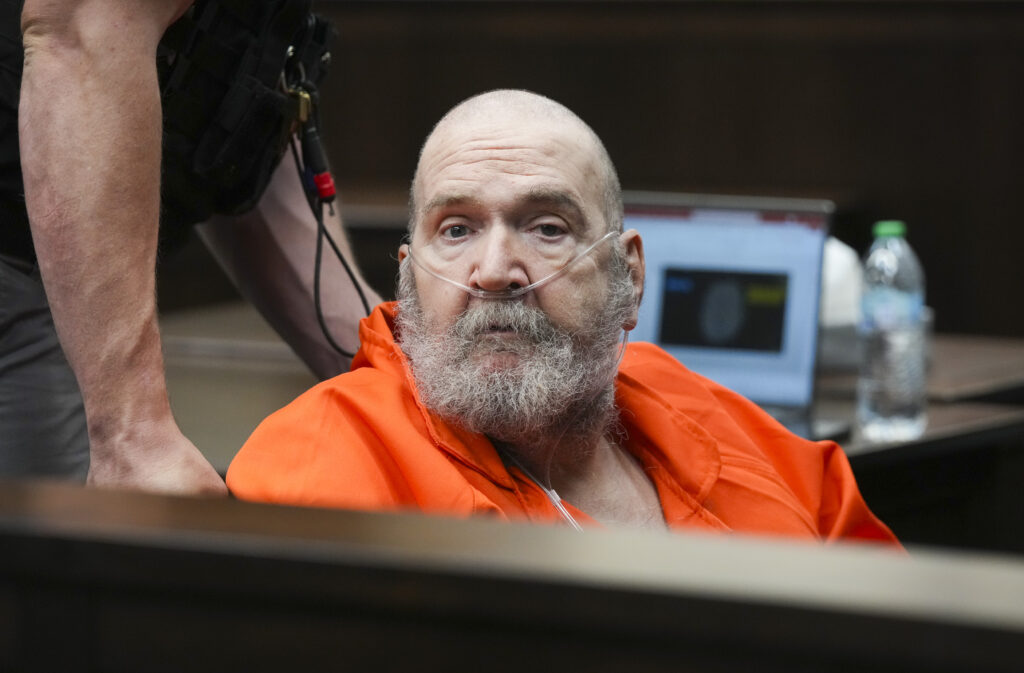


Ralph Menzies appears during his commutation hearing before the parole board at the Utah State Correctional Facility in Salt Lake City as he petitions to stop his execution by firing squad on Wednesday, Aug. 13, 2025. (Pool photo by Bethany Baker/The Salt Lake Tribune)
When campaigning for president in 1992, Bill Clinton raced back to Arkansas to oversee the execution of Billy Ray Rector. Clinton’s actions had nothing to do with addressing Arkansas’ record crime rates at the time. It was political theater. Mr. Rector’s crime was atrocious. He also suffered from mental illness to such an extent that on his way to be executed, he deliberately left behind the dessert from his last meal. He said he was “saving it for later.”
Yet Clinton believed it better politically to watch a mentally ill man put to death than to show mercy. Although sadly he may have been proven right, the execution is “remembered as a disgrace” to the state of Arkansas.
Utah may be poised to join Arkansas and other states as having executed a person with mental illness. After going over a decade without executing anyone, our state chose to execute Taberon Honie in 2024. Now the state seeks to execute Ralph Menzies.
In 1986, Mr. Menzies committed a terrible crime, kidnapping and murdering Maurine Hunsaker. Today, he is 67 years old. He relies on a wheelchair. He breathes with aid of an oxygen tank. And like Mr. Rector, he suffers with mental illness, having been diagnosed with dementia.
There is not an apparent reason why his crime compared to others requires the punishment of death. Combined with the 11 other people put to death or currently on death row, his crime represents less than one percent of the over 2250 murders in Utah between 1986 and 2024. By any definition, killing Ralph Menzies is an arbitrary infliction of extreme punishment for punishment’s sake only.
When the United States Supreme Court briefly abolished the death penalty in 1973, it was the arbitrary nature of its use that led to it being declared cruel and unusual in violation of the constitution. Justice Potter Stewart described that “death sentences are cruel and unusual in the same way that being struck by lightning is cruel and unusual.” He explained that for all the people sentenced to death, their crimes did not stand out for any reason other than they were among a “random handful upon whom” the sentence of death has been imposed.
As for Mr. Menzies, his crime does not stand out for any reason from the other notable, and thousands of less notable, murders over the decades in Utah. Mark Hofmann avoided the death penalty. He used bombs to kill two people to cover up a scheme to defraud The Church of Jesus Christ of Latter-day Saints. There is the “self-described ‘white-power skinhead’” who murdered Corrections Officer Stephen Anderson in an escape attempt. He too avoided the death penalty. Of the four other people on Utah’s death row, two sit there while their co-defendants do not.
It may be said that even if the death penalty is arbitrarily imposed, it must exist as a deterrent. Not so. The death penalty is not a deterrent. It is a fact that overall states without it have lower murder rates than states with it and that states that have recently abolished the death penalty saw no increase in their murder rates. In contrast, six of the seven states with the highest murder rates all have the death penalty, with five having executed someone since the start of 2024.
What about victims? Ms. Hunsaker’s daughter recently came out against the execution, writing that she does not “believe that justice will be served by taking another life.” Ms. Hunsaker’s son has publicly supported the execution, saying the family is ready for “closure.” No one can question his feelings or the reasonableness of wanting closure. But closure comes in many forms. What cannot be known is how anyone would feel about closure if the case had ended in any other fashion. As Mr. Menzies’ case typifies, waiting for imposition of the death penalty inhibits closure.
Which comes back to Mr. Menzies. Whatever led him to commit the horrendous crime is long since gone. Whoever he was then is not the person we see today. That is true due to the passage of time. It is true because none of us should be defined by the worst thing we ever did. And it is true because he is an elderly, sick man.
We can be better than this. Or Utah will go through with killing a man with dementia who needs an air tank to breathe. It will be our own unforgettable disgrace.