Utah News Dispatch
Effort to repeal Utah anti-gerrymandering law falls short after losing signatures

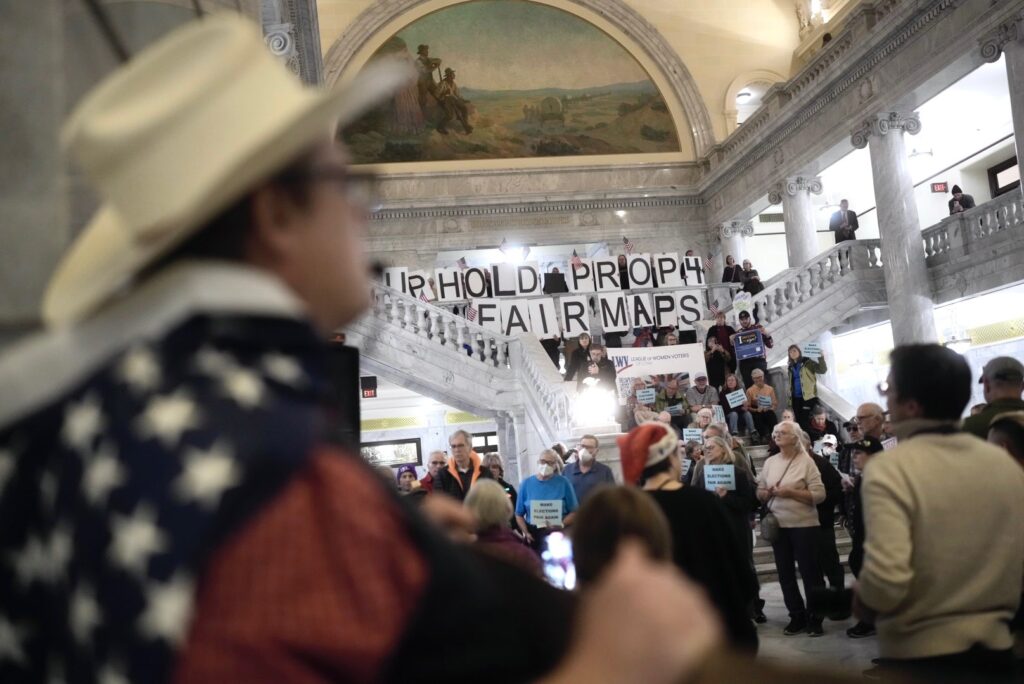

Protesters rally in support of Proposition 4 in the rotunda of the Utah State Capitol in Salt Lake City on Tuesday, Dec. 9, 2025. (Photo by Spenser Heaps for Utah News Dispatch)
The effort to ask Utah voters this fall to repeal an anti-gerrymandering law they approved in 2018 appears to have fallen short.
Thousands of the GOP-led petition signers have removed their signatures across the state — including hundreds in a key Senate district that dropped below the required threshold for the question to qualify for the ballot, according to updated tallies posted on the lieutenant governor’s website Thursday morning.
The initiative, however, won’t be officially disqualified until Lt. Gov. Deidre Henderson makes the call that it won’t appear on the November ballot. But because the window of time to add signatures has come and gone — with still weeks left for voters to remove their signatures by April 23 — the effort is on track to fail.
Utah’s anti-gerrymandering law may go back to voters: Prop 4 repeal effort files 200,000 signatures
Henderson, in a statement issued to Utah News Dispatch, said April 30 is her deadline to “declare the initiative sufficient or insufficient.”
“We will carefully review all data and ensure that counties have verified their numbers before making the declaration,” Henderson said.
According to an analysis of that data by the political consulting and public affairs firm Morgan & May, the repeal effort lost hundreds of signatures in the Democrat-majority Senate District 15, currently represented by Sen. Kathleen Riebe, D-Cottonwood Heights.
As of Thursday morning, that district fell 259 signatures short of the minimum 4,596 needed for the question to qualify in that district. Under Utah law, ballot initiative backers need to gather signatures from not only at least 8% of the state’s registered voters statewide, but also at least 8% of registered voters in at least 26 of the state’s 29 Senate districts.
The group Utahns for Representative Government (founded by the head of the Utah GOP) had gathered 5,254 verified signatures in Senate District 15, but as of Thursday 917 signatures had been removed, dropping that district to only 4,337 verified signatures, according to the Morgan & May analysis.
The repeal effort had initially gathered enough signatures in the minimum 26 of Utah’s 29 Senate districts, so opposition groups including Better Boundaries — the original sponsor of Proposition 4 in 2018 — that have been urging voters to remove their signatures only needed to tip the scales in one Senate district to doom the effort.
Misleading tactics, fraudulent signatures, assaults: Utah’s fight over Prop 4 is getting ugly
In a statement issued Thursday morning, Better Boundaries executive director Elizabeth Rasmussen indicated the group’s efforts to encourage voters to reconsider their signatures on the petition aren’t over.
“With reports suggesting the Prop 4 repeal may not qualify for the ballot, we will continue to help Utah voters who felt they were misled about what they signed to remove their signatures,” Rasmussen said, noting that after signatures are posted on the lieutenant governor’s website, Utahns still have 45 days to remove them.
“A well-informed voting population leads to better outcomes for everyone,” she said. “A majority of Utah voters approved Prop 4 in 2018 and we look forward to the day when Utah voters can finally pick their politicians, not the other way around.”
In a statement issued Thursday morning, Utah Republican Party Chair Rob Axson said Utahns for Representative Government isn’t done fighting for the repeal — either through a lawsuit or a future effort.
“We have significant concerns about the practices utilized by the opposition and continue to review the signature validation and removal process,” Axson said. “Given today’s update, we want to thank the hundreds of thousands of Utahns who signed our initiative. Utahns spoke loudly in the face of an unprecedented onslaught of biased media coverage, outside influence, and judicial interference.”
Axson added: “Whether now or in the future, by litigation or initiative, we will repeal Prop 4. This fight is not over but just beginning.”
The ‘fascinating’ dynamics in play for Utah’s 2026 congressional primaries
The Republican-led campaign to repeal Proposition 4 surfaced after Utah’s courts ruled that the 2021 Utah Legislature overstepped when it repealed and replaced it with a law that enabled them to ignore the voter-approved law’s ban on partisan gerrymandering, its neutral map-drawing standards, and an independent redistricting commission’s recommendations.
The redistricting lawsuit that successfully alleged that the Legislature violated Utahns’ rights to alter and reform their government via ballot initiative eventually led to 3rd District Judge Dianna Gibson voiding the Legislature’s 2021 congressional map as the result of an unconstitutional process. To remedy that unlawful map, she put in place a court-ordered map to be used for the 2026 elections. That map turned one of Utah’s four red congressional districts blue.
Those district court rulings have been largely based on a unanimous 2024 Utah Supreme Court ruling that made clear that under the Utah Constitution the Legislature cannot undo “government reform” ballot initiatives without meeting a high bar of “strict scrutiny” or showing a “compelling government interest.”
Special session for Amendment D 2.0? Lawmakers still eyeing their power over ballot initiatives
“Consequently, when Utahns exercise their right to reform the government through an initiative, this limits the Legislature’s authority to amend or repeal the initiative,” that ruling said. “This does not mean that the Legislature cannot amend a government-reform initiative at all. Rather, legislative changes that facilitate or support the reform, or at least do not impair the reform enacted by the people, would not implicate the people’s rights under the Alter or Reform Clause.”
Utah’s Republican legislative leaders have decried that ruling ever since, arguing that it created an unworkable standard when it comes to voter-approved ballot initiatives, calling them “super laws” that the Legislature can’t change. They continue to argue that the Legislature has the final say when it comes to law making, not voters.
The Legislature’s first attempt to make that change in the Utah Constitution, a ballot question called Amendment D, failed after it was voided by the courts for legislative leaders failing to meet constitutional publishing requirements and characterizing it in a misleading way on the ballot.
Senate President Stuart Adams, R-Layton, has said that lawmakers will likely try again to make clear that the Legislature and voters’ law-making powers are on “co-equal” footing, but lawmakers have yet to consider a resolution that would put that on the ballot.
It’s possible that the issue could be headed for a special session in coming months. But that hasn’t been confirmed, as the governor has not yet issued a call.
Adams, in a statement issued Thursday, said the apparent failure of the Proposition 4 repeal effort “doesn’t change the need to protect our republic.”
“We remain committed to restoring stability, upholding constitutional order and safeguarding the voice of the people,” Adams said, “because the future of our great state depends on it. We are working to make sure the people, not chaos, shape Utah’s future.”