
Utah News Dispatch
Death row inmate Ralph Menzies wins appeal, Sept. 5 execution called off


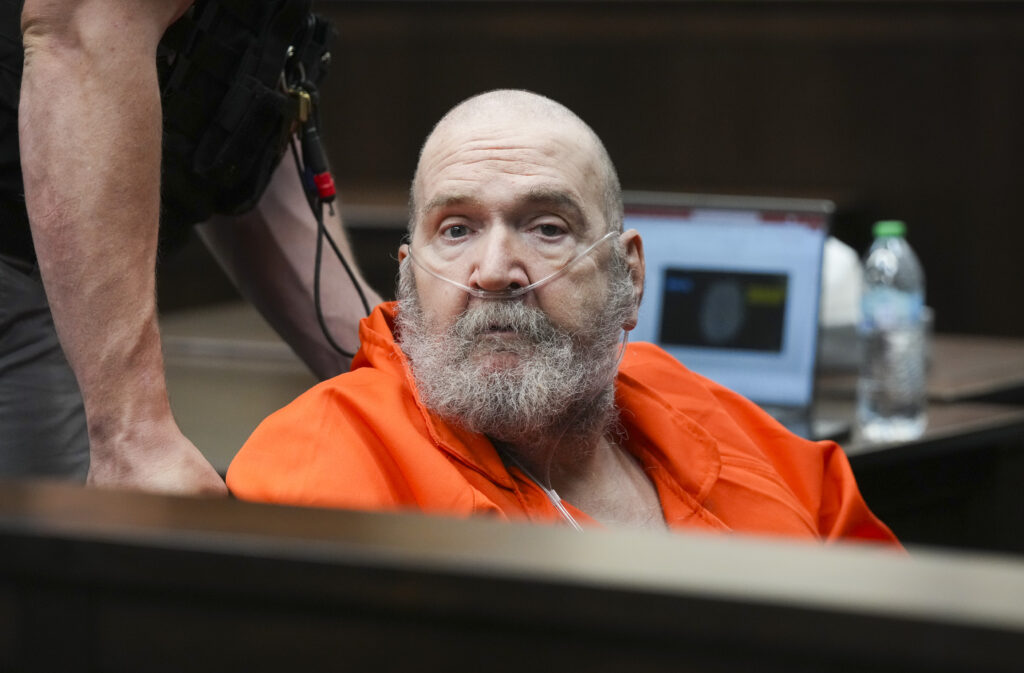


Ralph Menzies appears during his commutation hearing before the parole board at the Utah State Correctional Facility in Salt Lake City as he petitions to stop his execution by firing squad on Wednesday, Aug. 13, 2025. (Pool photo by Bethany Baker/The Salt Lake Tribune)
This is a breaking story and was updated at 6:00 p.m.
With less than a week before his scheduled firing squad execution, the Utah Supreme Court unanimously ruled in favor of death row inmate Ralph Menzies on Friday, effectively repealing his execution warrant.
Now, the 67-year-old with dementia will receive another evaluation to determine whether he is competent to be executed. That means his Sept. 5 execution will be delayed, and there’s a possibility that it will never happen.
It’s a major twist after more than a year of debate surrounding Menzies’ mental decline. Menzies was sentenced to death in 1988 for the murder of Maurine Hunsaker, but his attorneys have argued that his dementia has progressed, making him ineligible to be executed.
Death row inmates in the U.S. must have a “rational understanding” of why they’re being executed, per both state and federal law — that means they must understand the government’s reasoning for pursuing the death penalty, and know that their crime is particularly heinous.
Menzies’ attorneys say he doesn’t meet that bar. But earlier this year, Utah 3rd District Judge Matthew Bates ruled that Menzies, despite having dementia, was competent enough to be executed. The Utah Board of Pardons and Parole also denied Menzies commutation.
The Utah Supreme Court marked Menzies’ final appeal. And in a 23-page ruling issued Friday afternoon, the justices wrote Menzies’ “vascular dementia and its progressive effects call into question whether he remains competent to be executed.”
“We acknowledge that this uncertainty has caused the family of Maurine Hunsaker immense suffering, and it is not our desire to prolong that suffering. But we are bound by the rule of law,” the opinion reads.
The question before the state’s high court was whether Menzies should get another competency evaluation. Several doctors and medical experts evaluated Menzies last year, and over several days presented their findings to Bates, who ruled in June that the execution should move forward.
In July, Menzies’ attorneys filed a petition for another competency review, arguing that his dementia had worsened since the initial evaluations, which were done last year. Corrections staff noticed his mental decline, and medical experts who reviewed Menzies reported “a new inability in his understanding of his death sentence,” according to court documents.
Bates denied that request on Aug. 14 — last week, Menzies’ attorneys made their appeal to the Utah Supreme Court, a last-ditch effort to avoid the firing squad.
Utah law sets a high bar to allow for a second competency evaluation. There must be valid allegations of a “substantial change” in the inmate’s circumstances since the prior evaluation; and those allegations must be “sufficient to raise a significant question” about the inmate’s competency.
SUBSCRIBE: GET THE MORNING HEADLINES DELIVERED TO YOUR INBOX
Attorneys for the state say he didn’t show enough evidence to warrant another hearing, arguing that certain exhibits were incomplete. And Bates ultimately agreed.
However, the ruling on Friday found that Bates, when he denied the petition for another hearing, “minimized” expert reports that suggested Menzies’ condition had worsened. The ruling sends the case back to a lower court.
“We reverse the district court’s order denying Menzies’s petition for reevaluation, vacate the warrant of execution and remand to the district court for further proceedings,” the ruling reads.
It’s unclear how long this could delay Menzies’ execution, and it’s possible that the lower court will find that the inmate now meets the threshold to be considered incompetent, meaning he would spend the rest of his life in prison. In their ruling, the supreme court acknowledged their decision “may cause additional delay.”
In a statement, Utah Department of Corrections Executive Director Jared Garcia said he respects the ruling, and his team “will continue to carefully monitor the situation and remain prepared to carry out the sentence of the court when and if we are called upon to do so.”
Menzies’ attorneys celebrated the ruling, telling Utah News Dispatch they look forward to making their case as to why the death row inmate is no longer competent to be executed.
“We are pleased that the Supreme Court has ensured Mr. Menzies will not be executed without the benefit of an updated, independent competency evaluation,” said Lindsey Layer, one of Menzies’ attorneys, in a statement. “It has been more than a year since his last evaluation, during which time his dementia has significantly worsened. He’s tethered to an oxygen tank, uses a wheelchair, is confused and disoriented, and no longer understands why the State of Utah is trying to kill him.”
Matt Hunsaker, Maurine’s son, said in a text message his family is “distraught and disappointed” and asked for privacy. The Utah Attorney General’s Office said it is reviewing the decision, and had no statement as of Friday afternoon. The Utah Department of Corrections said it would be releasing a statement soon.
Menzies already had a lengthy criminal history when he murdered Hunsaker in 1986. Fresh out on bail for theft, he kidnapped the 26-year-old mother after robbing the Kearns gas station where she worked, and brought her up Big Cottonwood Canyon. Days later, she was found with her throat slashed, and evidence suggested she had been tied to a tree and strangled.
SUPPORT: YOU MAKE OUR WORK POSSIBLE
Years of appeals followed, and in 2024 the Utah Attorney General’s Office applied for an execution warrant. By then, Menzies had already been diagnosed with vascular dementia.
Scans showed Menzies’ brain was shrinking and experienced hemorrhages, and evidence suggested he was falling often, would occasionally lose consciousness and suffer from hypoxic events (which is when the brain isn’t getting enough oxygen).
Menzies’ attorneys had several pending appeals that the court’s Friday ruling addressed. They had asked the court to pause execution proceedings, which the court effectively did by allowing the second review. And, they had appealed Bates’ initial ruling that found Menzies competent, which is no longer valid since they are allowing the reevaluation.