Utah News Dispatch
Change of homelessness leadership in Utah comes at a ‘unique moment,’ new boss says


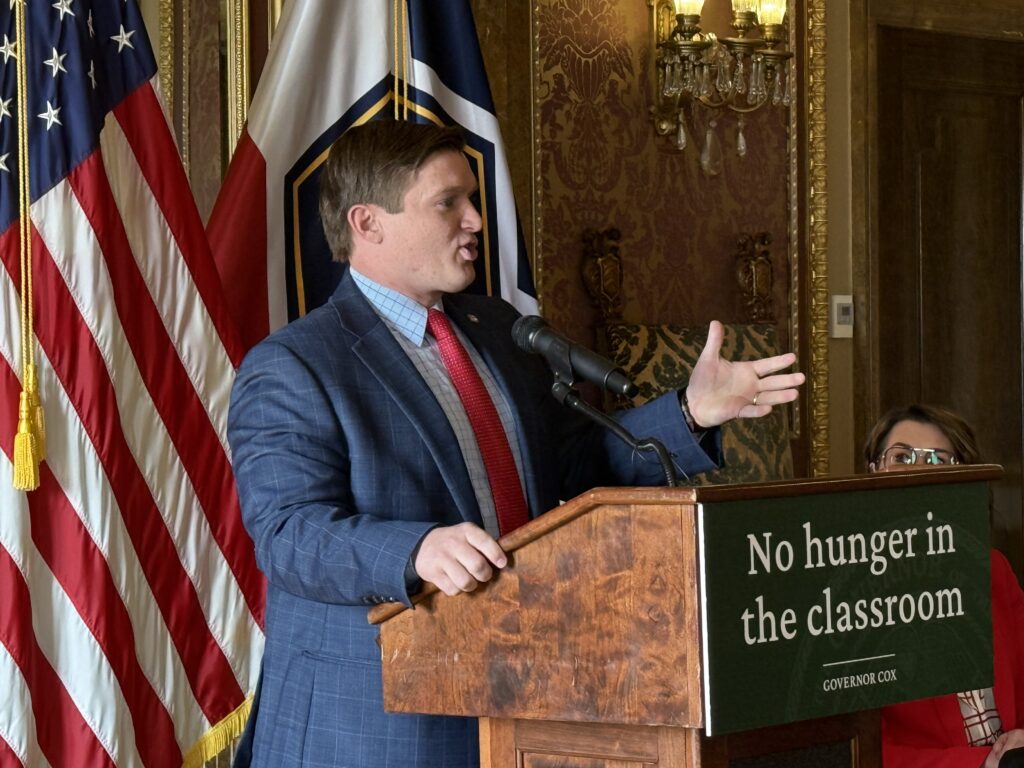


Rep. Tyler Clancy, R-Provo speaks at a ceremonial bill signing at the Utah State Capitol on April 15, 2025 (Alixel Cabrera/Utah News Dispatch)
Rep. Tyler Clancy, who currently works as a detective with the Provo Police Department, admitted that when he was first approached by the governor’s office about becoming the state’s next leader of Utah’s Office of Homeless Services, he said he turned down the job “a couple of times.”
He knew the role of state homelessness coordinator is a tough job, tasked with navigating a complex web of state and local systems on controversial issues impacting the lives of the state’s most vulnerable.
Clancy, R-Provo, said he was mostly reluctant to step down from representing District 60 in the House and leave his job in law enforcement. But the position makes sense for Clancy, who during his time in the Legislature has sponsored several bills focused on homelessness policy.
Clancy eventually accepted, he said, because he sees Utah — and the federal government — at a crossroads when it comes to changing the way homeless services function.
“We’re in a unique moment,” Clancy said in an interview last week with Utah News Dispatch. “And this is where I can make an impact and continue to serve my state.”
Gov. Cox picks lawmaker with police background as new state homeless coordinator
Last month, Gov. Spencer Cox announced Clancy would be taking the place of the state’s current homelessness coordinator, Wayne Niederhauser, after he retires on Dec. 5. Clancy was publicly named Niederhauser’s successor just nine days after Niederhauser’s retirement announcement.
Clancy won’t step into his new job as state homeless coordinator until after the Utah Legislature’s 2026 session, which begins Jan. 20 and ends March 6. But come March 9, he’ll no longer be called Rep. Clancy.
Call him Coordinator Clancy.
Niederhauser, Clancy acknowledged, leaves some “big shoes to fill.” A former state Senate president, Niederhauser has long been lauded as a skilled collaborator with strong relationships and trust on Utah’s Capitol Hill, which has been key for significant new investments in the state’s homeless system over the past five years.
“It’s a daunting task,” Clancy said of replacing Niederhauser. “I don’t know that if there’s a state or a city we can look and say, ‘Well they got (homelessness) right.’ That’s what we’re really trying to do, be a leader in the space to find results-oriented solutions that help people heal and continue on their path to self-sufficiency.”


Niederhauser, in a recent interview with Utah News Dispatch after his retirement announcement, said when he took the job in 2021, he didn’t expect to stay as long as he did — but come December, he said he felt it was time to “pass the baton.” He said it was a “mutual decision” between him and the governor.
“It’s not an easy space. It’s fraught with controversy and politics and all of that, and you know, some fresh energy, I think, will be really good,” Niederhauser said. He added that the “politics have changed” over time, including on the federal level, “and so we need some fresh energy, some fresh ideas, and we’ll just hand the baton off and go from there.”
What’s next?
Niederhauser’s departure announcement comes at a time when a major project is unfinished: a proposed 1,300-bed “homeless campus” that the governor has thrown his full weight behind, recently calling it a “top priority” as he begins to prepare his 2026 budget recommendations for lawmakers.
Finding funding for the expensive project — estimated to cost at least $75 million to build and more than $34 million a year in ongoing money to operate — will be a major obstacle, but the governor said he hopes some federal dollars could help make it a reality.
Utah Gov. Cox says homeless campus — envisioned to fulfill Trump’s order — is a ‘top priority’
That “transformative” campus is key for the governor and other state leaders’ vision to not only increase the state’s currently maxed out homeless shelter capacity, but also make homeless services more focused on “healing” and “accountability.”
Plans for the campus are still taking shape. But the state’s top homelessness leaders have proposed including hundreds of beds for people who are civilly committed — or court ordered into mental health treatment — along with a “secure” facility for substance abuse treatment as an alternative to jail, where people who are “sanctioned” to go there would not be able to leave voluntarily.
How Trump’s vision fits in
Their vision coincides with President Donald Trump’s executive order issued in July, titled “Ending Crime and Disorder on America’s Streets.” That executive order encourages cities and states to enforce stricter anti-camping laws, expands power to involuntarily treat and civilly commit people experiencing homelessness, and directs federal officials to end support for “Housing First” strategies, an approach to homelessness that prioritizes providing housing while offering — but not requiring — treatment.
But months before Trump’s executive order, Utah’s Republican state leaders had said they wanted Utah’s homeless system to start moving away from Housing First policies — policies the state once championed — that they now say “lack accountability.”
Clancy, earlier this year, successfully sponsored a resolution urging the federal government to change federal homelessness regulations to provide more flexibility for federal homelessness funding. “Block grant funding,” the resolution says, “would provide Utah with tools to better leverage” Department of Housing and Urban Development money “by granting the state more discretion over the allocation of funds, enabling local agencies to design more effective programs tailored to the specific needs” of Utah’s homeless population.
Utah officials unveil site for 1,300-bed homeless campus after long, secretive search
That resolution (approved by the Legislature and signed by the governor in February) also included a request to “rescind housing first policy mandates to permit flexibility” for housing options that “meet the diverse needs and preferences of families experiencing homelessness, including sobriety, goal-setting, and accountability.”
Clancy said that’s context he feels has been looked over as Utah recently gained national attention after The New York Times published an article titled “In Utah, Trump’s Vision for Homelessness Begins to Take Shape.”
“We were working really hard on this mission of reform before President Trump took office,” he said. “We’ve been working on reforming Housing First, looking at an all-of-the-above model, even when President Biden was in office.”
Clancy said Utah state leaders’ vision aligns with Trump’s — including expanding mental health care “for those who really do need those acute mental health services,” he said. He added that he’s “confident” that Utah leaders will “continue to collaborate” with the Trump administration as they figure out next steps.
What are those next steps? Clancy said that resolution “puts Utah in the driver’s seat to help lead the way” since “we have already identified that we’re willing to do this.”
Clancy talks next steps
If not for the ongoing government shutdown, Clancy said “we would be having a lot of those conversations. But the minute it reopens, we’re going to be working very, very closely with the Trump administration to get every dollar and cent that the state of Utah can get.”
“We will work for that and make sure that we’re using that money to help save lives and change lives,” he said.
Clancy said due to legislation passed over the past several years, Utah’s existing homeless system has already been set up “to be ready” for whenever the federal government changes how funds are distributed through local homeless services networks known as “continuums of care.”
So whenever the changes are enacted on the federal level, providers who receive the funding will be allowed to enact more “accountability” requirements, he said. Now it’s just a matter of when the federal government will act.
“So I think what’s next is for the federal government to repeal those very restrictive (Housing First) rules on the existing federal funding,” Clancy said.
But for now, due to the shutdown, “we’re kind of in that holding pattern,” he said, but “Utah is ready to act on that mission.”

Concerns and criticism
Big changes don’t come without trepidation. In recent months, some homeless providers have been feeling nervous and skeptical about whether the changes will actually help more people — or create more punitive and chilling policies that could leave more people falling through the cracks, deprioritize permanent supportive housing and destabilize people who are currently housed.
In a July letter urging the state’s Homeless Services Board to “fulfill” Trump’s executive order, the governor, House Speaker Mike Schultz and Senate President Stuart Adams said to, among other things, “ensure any funding requests are accompanied by a clear strategy that aligns with the President’s executive order, with a focus on reprioritizing existing resources.”
How can the state “reprioritize” existing funding without leaving some housing or homeless service providers unfunded? Clancy said, to him, “reprioritization is more about recognizing what are the unique challenges” facing certain “subpopulations” of homelessness and “making sure we’re matching appropriate funding to those needs.”
SUBSCRIBE: GET THE MORNING HEADLINES DELIVERED TO YOUR INBOX
“If there’s a program or programs that are not successful, the onus would be on every government official to make sure that we’re being wise stewards of taxpayer dollars,” Clancy said, but he added he doesn’t see it as something that will jeopardize needed housing programs during a time when Utah’s housing affordability issues are worse than ever.
Instead, he said he sees it as an opportunity to allow — but not require — providers to add “accountability measures” on programs. Under current federal policies, Clancy said “right now, there’s a prohibition,” but reprioritization would mean “removing that restriction and then seeing where the results lay.”
“When we talk about Housing First, it’s this idea that severe addiction and severe untreated and persistent mental illness will magically melt away if you give someone a key to a single-room occupancy apartment,” he said. “That, I think, you’re going to see a shift away from. Does that mean we still don’t need capacity? No, of course we do. But how is that capacity linked to engagement?”
Some, including Democrats and homeless service providers, have criticized the “homeless campus” proposal as an expensive project that will need to be fully funded in order to succeed — but meanwhile, the state’s current homeless shelters and other existing resources like deeply affordable housing, substance use treatment, mental health treatment, and jail capacity have long gone underfunded.
‘Compassion that kills’: Gov. Cox says ‘sea change’ in Utah’s homeless system is coming
Clancy acknowledged those criticisms — and to a certain extent he agrees, “particularly in the mental health space,” he said, especially for people who are facing “serious psycho-effective disorders” to the point they may not realize they’re mentally ill and they’re living on the streets in the middle of winter.
“That’s where I would probably agree with critics who say, ‘This is heavily driven by funding,’” he said, but he added he would “disagree” when it comes to other people who “cycle through the same programs six, seven, eight times, to no success because it’s not meeting the severity of their needs.”
Clancy said he believes he’s not criticized for advocating for more funding — but rather for highlighting “the need for higher engagement programming” to add more accountability measures on services for people suffering from drug addiction or other issues.
“What we’re talking about is not involuntary versus voluntary treatment,” he said. “We’re talking about voluntary treatment or an unchecked spiral into this world of hell.”
As for mental health capacity, Clancy said he doesn’t see a need to drastically change Utah’s existing laws in order to civilly commit more people than already qualify for that legal status — but rather he said the state needs to focus its efforts on increasing capacity.
Utah’s new homeless campus should have 300-plus beds for civil commitment, board chair says
In September, Rep. Steve Eliason — a lawmaker who has a long track record of legislation related to homelessness, mental health and civil commitment — estimated that there’s “at least 1,000 people under civil commitment on the streets” with no available inpatient beds for them.
“So that’s where I think when we talk about working together with the federal government, it’s about making sure our mental health services have the right funding to make sure we can match people up with the needs that they have,” Clancy said. “In Utah in particular, I think we’re in a really good place with civil commitment on the legal level, but our challenge is largely driven by capacity.”
While critics see Utah’s vision as one focused on treating homeless people like criminals, Clancy said it’s more of a matter of putting “treatment” and “recovery” first.
“We want that system of care to be recovery focused, for people who have faced serious trauma in their lives,” he said. “It’s not a one-size-fits all issue, we always say that. But now it’s time to put it into action.”