Utah News Dispatch
Bill would require coursework accommodations for college students with deeply held beliefs


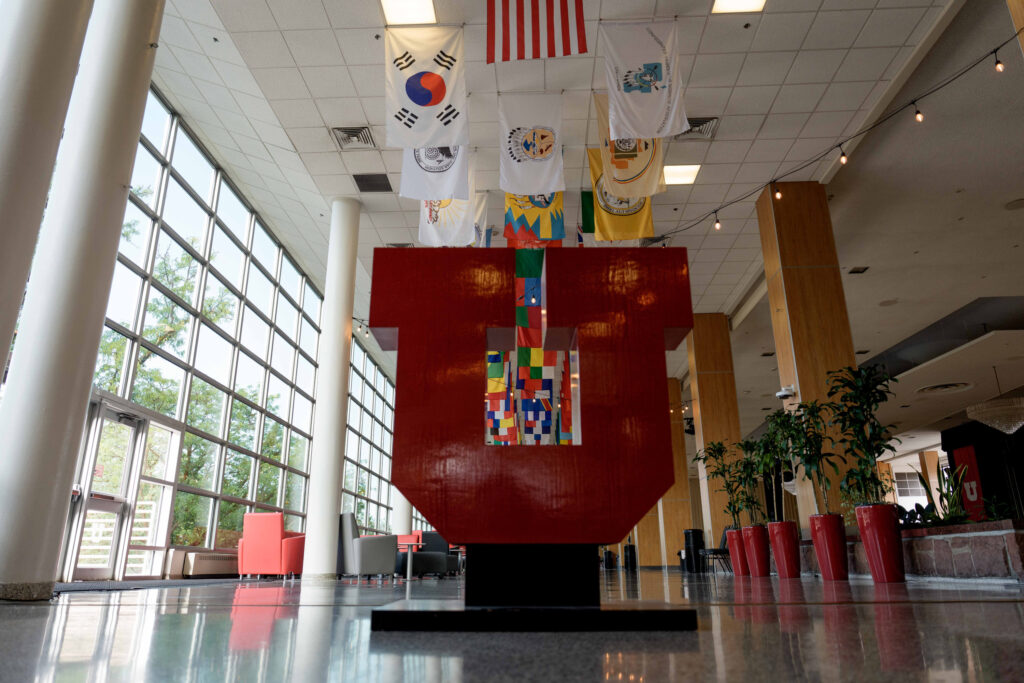


The A. Ray Olpin Student Union building on the University of Utah campus in Salt Lake City is pictured on Saturday, Aug. 23, 2025. (Photo by Spenser Heaps for Utah News Dispatch)
Utah lawmakers are considering a bill that would require colleges and universities to offer alternative assignments or exemptions when coursework violates a student’s deeply held beliefs — including religious ideals or objections based on conscience.
HB204 is sponsored by Rep. Michael Petersen, R-North Logan, and received a favorable recommendation from the House Education Committee in an 8-1 vote Wednesday. The bill would require public higher education institutions to make accommodations for students whose coursework comes into conflict with their religious beliefs and conscience, as long as the accommodation does not interfere with the essential education requirements of a course.
Petersen told Utah News Dispatch “the intent is to make sure students aren’t required to do things that violate their conscience in order to save their grade,” with critics arguing it could worsen educational outcomes, weaken academic standards, and limit students’ exposure to challenging ideas.
What inspired the bill
Presenting his bill to the committee, Petersen shared an experience he had with his daughter, a college student who received an assignment that made her uncomfortable.
“She called and said ‘I’m supposed to write a letter to a legislator advocating for LGBTQ policy,’ and she asked if I could help her,” he said. “As I’ve been holding town halls, I’ve had several people come and tell me they’ve had similar kinds of situations where they’ve been given assignments that violated their conscience.”
SUPPORT: YOU MAKE OUR WORK POSSIBLE
Robin Wilson, a law professor at the University of Illinois who spoke in a personal capacity, told the committee she has heard of professors “coercing students.”
She said forcing students to do something that violates their beliefs “would violate the First Amendment to the U.S. Constitution, namely, its protection for free speech.” Wilson added that the bill has a broad scope, as it includes two grounds for accommodation — religion and a student’s conscience.
“That second ground ‘conscience’ is important, because religious reasons don’t cover all objections,” she said. “For example, a student might not want to write a paper arguing for a clean needle exchange for addicts as a form of harm reduction, something that could be asked for in a public health course.”
Opposition to the bill
Some educators argued the bill would worsen education outcomes overall by limiting students’ exposure to challenging materials.
“Exempting students or providing accommodations around assignments that violate their conscious objection decreases the viewpoint diversity and doesn’t expose students to these challenging views,” said Gabe Byars, an occupational therapy professor at Salt Lake Community College who spoke in a personal capacity.
He said he thinks “ideas should have the ability to be debated and discussed,” emphasizing that “the right idea comes to the surface.” He also criticized the bill as enacting insignificant change.
“Many of the ideas in this bill are already permissive by Utah law,” he added. “We have institutional neutrality. We have our syllabus database in advance … we’ve had a lot of great conversations about academic freedom and viewpoint diversity.”
If a student can opt out of required material based on a conscience objection, that student may not be able to meet licensure requirements.
– Brianne Kramer, chapter president of the American Federation of Teachers Utah College Council at Southern Utah University
Brianne Kramer — Southern Utah University chapter president of the American Federation of Teachers Utah College Council — spoke in opposition to the bill, referencing “state licensure and national accreditation, like health care and behavioral health, education, finance and accounting legal professions.”
“These programs are not free to decide what to teach. We are required by accrediting bodies to ensure that every student demonstrates specific mandatory competencies,” she said. “If a student can opt out of required material based on a conscience objection, that student may not be able to meet licensure requirements.”
She raised ethical questions about how a health student’s belief system could affect their patient in the future, citing marriage and counseling issues.
“It also raises real, practical questions,” she said. “For example, could a student (in a) mental health counseling program object to learning how to counsel married couples because they do not believe in marriage?”
No impact to ‘essential’ course material
Under HB204, colleges and universities would be required to provide accommodations when curriculum conflicts a student’s beliefs, unless doing so would fundamentally alter the course or degree.
“We recognize the need to master essential learning outcomes of the course,” Petersen told the committee. “I worry that some of the folks, some of the comments, and some of the commenters, hadn’t read the substitute.”
A substitute to the bill prevents accommodations from impacting the essential nature of a course or making a fundamental alteration.
“There’s a guardrail around the impact to accreditation, or even to a student’s learning,” Wilson told the committee. “That is this idea of a fundamental alteration that’s done at the institutional level.”
Fundamental alterations refer to “a change so significant that it alters the essential nature of the degree or the course,” she explained. Wilson said each institution would determine if the accommodation negatively affects the student’s ability to master a course through a third party associated with the program in question.
She also said the bill would keep students from enrolling in programs they could not complete, given fundamental disagreements with essential course materials.
“(The bill) keeps students from enrolling in a climate science major and objecting to every single assignment as a climate climate objector,” she said.
SUBSCRIBE: GET THE MORNING HEADLINES DELIVERED TO YOUR INBOX