
Utah News Dispatch
Amid civil commitment debate, Salt Lake County DA explores mental illness in justice system


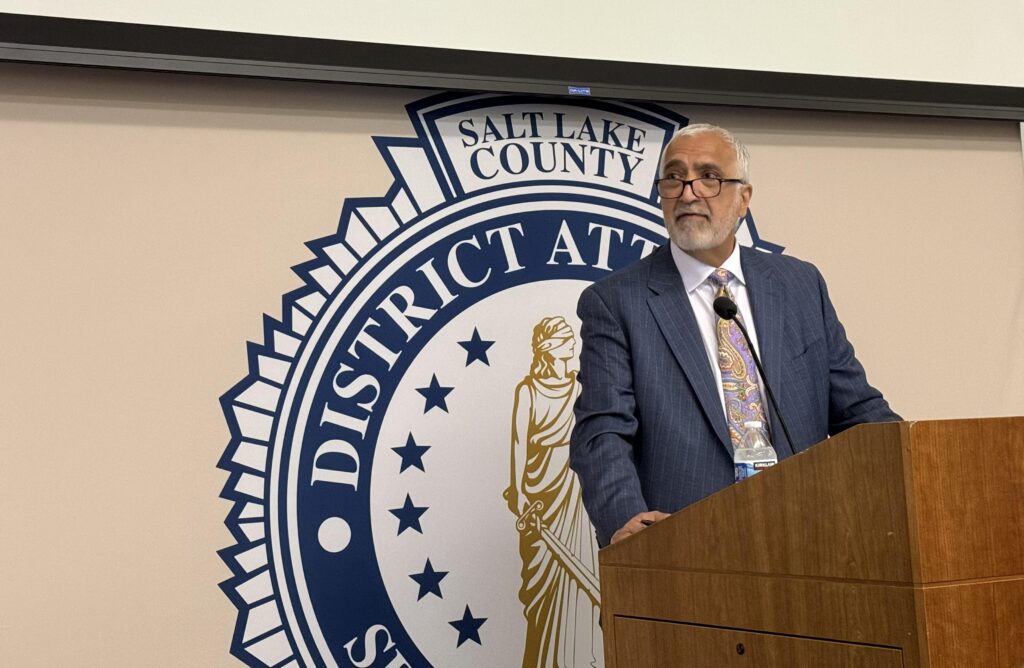


Salt Lake County District Attorney Sim Gill speaks during a criminal justice and mental health symposium on Sep. 24, 2025. (Alixel Cabrera/Utah News Dispatch)
Salt Lake County District Attorney Sim Gill still remembers one of the most difficult calls of his time as a public prosecutor. It was an elderly woman with a severely mentally ill adult child.
Without access to many resources and feeling increasingly exhausted as she and her husband got older, she asked an unimaginable question — what felonies could her son commit to get help from the county’s mental health court?
“That experience reminded me, early on, the impact of mental illness, not only on families and loved ones, but how broken our institutional support had been,” Gill said during a criminal justice and mental health symposium on Wednesday.
SUBSCRIBE: GET THE MORNING HEADLINES DELIVERED TO YOUR INBOX
The largest mental health facilities in the U.S. are New York City’s Rikers Island, Twin Towers Jail in Los Angeles and Cook County Jail in Chicago, demonstrating that the criminal justice system is a critical mental health provider, Gill said.
There is a disproportionate presence of people with mental illnesses in jail, compared to the general population, Gill said. And nearly 25% of all police shootings involve an encounter with a mentally ill person — but that’s a number he said he may contest, since in his experience overseeing reviews of over 150 officer-involved shootings in the last 15 years, Gill believes that percentage has been higher.
In this scenario, and with underfunded mental health centers and a reliance on low-level courts to manage mentally ill offenders, Gill said the state needs to think about the resources it puts forward for the federally-proposed expansion of civil commitment.
Utah’s new homeless campus should have 300-plus beds for civil commitment, board chair says
Utah is already studying ways to increase its number of civil commitment beds, with a proposal to add over 300 beds to the state’s new homeless services campus in northwest Salt Lake City, a measure that could be a step for the state’s response to Trump administration’s controversial “Ending Crime And Disorder On America’s Streets” order.
Utah Gov. Spencer Cox has also called for a mental health expansion in the state, arguing there should be more resources for patients “who are killing themselves slowly on our streets.”
With the lack of infrastructure to serve this population, it should come as no surprise that many patients who have lost shelter and access to medications may drink in excess or use illicit drugs, Gill said.
“The criminalization of public health issues became our norm. You and I would not criminalize somebody with heart disease, you and I would not criminalize somebody for having diabetes,” Gills said. “Unfortunately, mental illness, driven by shame, stigma and fear, continues to be criminalized, even today.”
Added to that, city justice courts, which handle low-level offenses like public intoxication, trespassing, disorderly conduct and camping, among others, don’t have the resources to address the complexity of individuals with mental illnesses either, Gill said.
Missing a court appearance, for example, could escalate a case, overwhelming the mentally ill population with a cycle of warrant after warrant.
“I think we need to recognize and acknowledge that systemic failure,” Gill said. “And please, when I say this, I am not trying to blame anyone. I’m just trying to share an observation, because if we do not honestly make an observation, we will never be in a place to effectuate the change that I know that all of you and all of us talk about.”
The county has also signed a contract with the Leifman Group — a consulting firm led by Steven Leifman, a retired judge who has developed substantial criminal justice reforms for people experiencing mental illness in Miami Dade County — to identify gaps in Salt Lake’s system.
“We really are focused on this work. And I’ll tell you, I’ve worked on it every day. Keeps me up at night. My brain is constantly thinking about it because I don’t like the outcomes that we’re seeing. And I also know that criminal justice is not the space where we want people to land,” Kelly Colopy, director of the Salt Lake County Human Services Department said.