
Utah News Dispatch
Ahead of Olympics, Salt Lake City shares environmental wins to mitigate air pollution and emissions


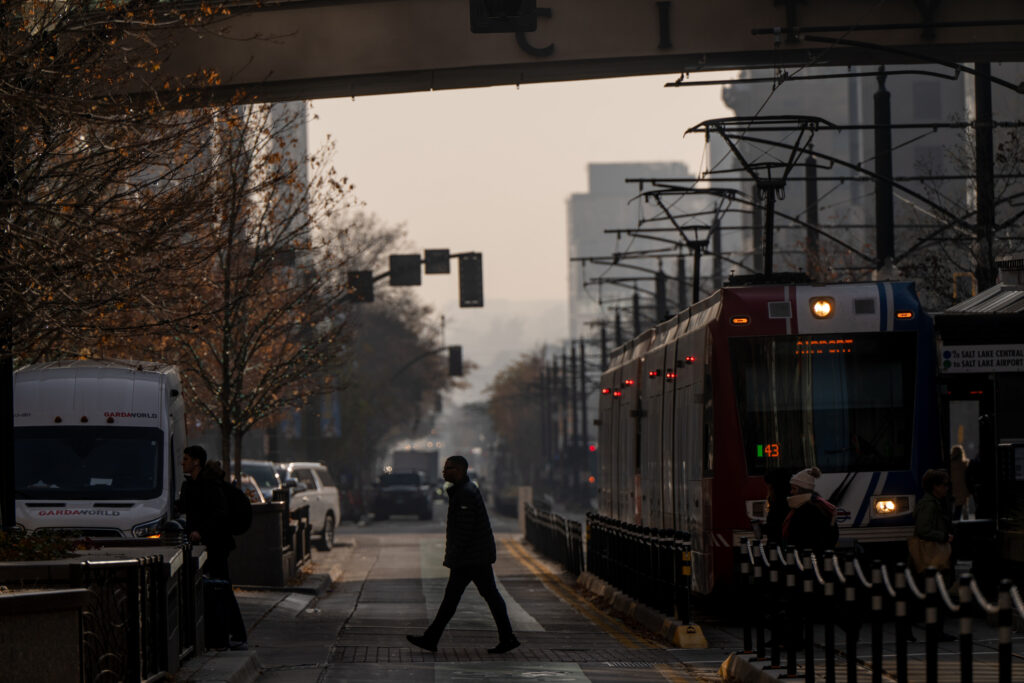


A haze of particulate pollution hangs over downtown Salt Lake City on Friday, Dec. 6, 2024. (Photo by Spenser Heaps for Utah News Dispatch)
While the federal government steps away from climate agreements, Salt Lake City is reiterating its commitment to become more sustainable ahead of the 2034 Olympic Games with a 2040 deadline to achieve goals to reduce greenhouse gas emissions and air pollution.
In an update presented to the Salt Lake City Council on Tuesday, the city’s Sustainability Department highlighted milestones, including a major one — the city’s greenhouse gas emissions fell 11% from 2009 to 2024, said Catherine Wyffels, air quality and environmental program manager at the department.
“This is primarily due to a shift to cleaner energy sources,” Wyffels said in a presentation. “So while this 11% may not seem like much, it’s important to remember that it happened during a period of a lot of growth.”
SUBSCRIBE: GET THE MORNING HEADLINES DELIVERED TO YOUR INBOX
Per capita emissions also declined 25% in the same period, she said. But there’s still a long way to go to meet the city’s climate goals.
After conducting surveys across the city with a special focus on the west side, which disproportionately experiences the effects of pollution, the city found that Salt Lakers’ top environmental concerns are drought and air quality.
“People are interested in anything they can do in their homes to save under utility bills,” she said. “A lot of support for clean renewable energy for both homes and businesses. People like street trees in their neighborhoods, and then also a lot of support for increased access to transit, walking and biking infrastructure.”
All of those are solutions to the city’s primary climate risks, which according to the Sustainability Department, are driven by rising temperatures and changing precipitation patterns.
The report presented to the City Council is still preliminary and is scheduled for an update next spring. Whenever it’s done, the city hopes it can help trace a path to achieve its goal to be 100% powered by renewable energy by 2030 and cutting 80% of emissions by 2040.
Salt Lake City is in the top three metro areas in the country for urban heat island intensity, with the west side of the city feeling those effects more strongly, Wyffels said. Urban development amid continued growth is expected to exacerbate the issue.
The city’s sustainability department also highlighted some achievements including an 80-megawatt solar farm that provides a lot of the city’s municipal energy and has saved around $1.5 million in electricity bills, said Sophia Nicholas, deputy director at the city’s Sustainability Department.
“We have a lot of the solutions at hand. We just need to have the wherewithal, political will, money, to implement them on a global basis,” Nicholas said. “And it is happening actually in other countries, but when you’re looking at our emissions profile in Salt Lake City in particular, about half of it comes from electricity, and that’s why it’s been so exciting to see that we have realized a reduction in our electric grid carbon intensity due to investments in a cleaner grid.”
Despite the progress there are still some issues. Seasons in Salt Lake City are getting hotter, Nicholas said. In the last 50 years, the average temperature in Utah has risen more than 2.5 degrees Fahrenheit, about twice the global average.
“That may not sound like much,” she said during the meeting, “but a few degrees change in the average temperature means our city and our region is and will continue to experience increasing drought, wildfires, flooding, extreme heat days and poor air quality.”
The city met federal air quality standards
For 15 years Salt Lake City and Provo, some of the densest cities in Utah were nonattainment areas for the Environmental Protection Agency’s 24-hour standards for fine particular matter pollution known as PM2.5. This month, however, the federal agency announced both municipalities were finally in compliance.
“The achievement of cleaner air in Utah resulted from extensive planning and collaboration among the public, industry, and various government levels, leading to significant investments and the implementation of 23 new rules targeting emissions from multiple sources,” Bryce Bird, director at the Utah Division of Air Quality, said in a statement.
He pointed to some efforts supported by the state Legislature, including incentives for retrofitting and replacing high-emission wood stoves and diesel vehicles, as well as transit updates and education campaigns.
However, in terms of energy, the state also modified its policy in 2024 to consider energy resources by listing these attributes in order of priority: adequate, reliable, dispatchable, affordable, sustainable, secure and clean. That law worried environmentalists, who said it could lead to the prioritization of coal and move the state away from a strong market of renewables.
Utah has also criticized the federal air quality regulations, even disputing Environmental Protection Agency air quality rules in court.