
Utah News Dispatch
A diamond provision hidden in a rough bill: Compensation expanded for victims of nuclear testing


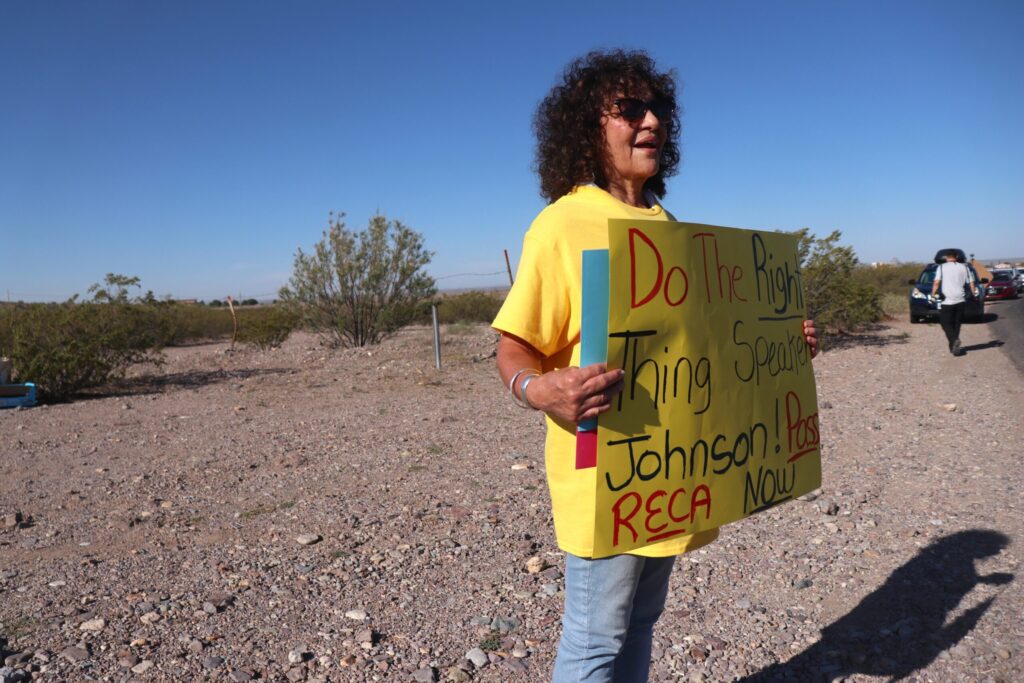


Tina Cordova, a founder of the Tularosa Basin Downwinders Consortium, protests in support of RECA expansion on Wednesday, Aug. 21, 2024. (Danielle Prokop/Source NM)
In June of 2024 during the 118th Congress, House Republicans failed to renew the Radiation Exposure Compensation Act (RECA) despite two attempts by Senate Republicans, leaving victims of nuclear testing and uranium mining without compensation for related health conditions. As affected people in Utah and other Western states struggled to support themselves with their health conditions, communities rallied for RECA’s reinstatement, collecting hundreds of public comments and conducting meetings with Sen. John Curtis, R-Utah, and Rep. Blake Moore, R-Utah, to discuss the importance and positive impacts of RECA.
RECA was initially passed in October of 1990 and provides compensation for victims of nuclear weapons testing, known as “downwinders,” and people employed in the uranium industry who developed certain eligible diseases as a result of that exposure. However, compensation was limited to only a handful of Western states and downwind counties, and only covered a few health conditions.
In mid-June of this year, Sen. Josh Hawley, R-Mo., announced that expansions to RECA would be included in the controversial Budget Reconciliation Bill — also known as “the Big Beautiful Bill” by members of the Republican Party.
The Budget Reconciliation Bill focuses primarily on supplying $4.5 trillion in tax cuts for the ultra-rich. It also takes aim at immigrants, providing billions for the U.S.-Mexico border wall, additional ICE agents and Border Patrol officers, and migrant detention facility beds. Notably, health care and other life-saving services are under attack by the bill, which will result in millions of Americans losing access to Medicaid and food stamps. The bill will also rapidly phase out Biden-era tax credits for wind and solar, driving up energy costs and making the energy grid less reliable. This bill will add $4.1 trillion to the national debt, something that directly clashes with the Trump administration’s stated goals. Overall the bill will harm everyday Utahns to pay for tax cuts for billionaires. The RECA expansion is a small but notable exception that will benefit Utahns and Americans across the West.
The provision will expand areas eligible for compensation for nuclear downwind radiation to all of Utah, New Mexico, and Idaho, as well as to Arizona’s Mohave county; Nevada’s downwind coverage areas will remain the same. Exposure eligibility dates will be extended from 1958 through to November of 1962. Compensation for on-site participants and “downwinders” will also be increased to $100,000, from $75,000 and $50,000 respectively. Certain communities in Missouri, Tennessee, Kentucky, and Alaska impacted by radioactive waste will be provided coverage as well. For uranium miners, coverage is expanded to other mining roles and additional health impacts that were previously uncovered. It is also extended to workers affected between the years of 1971 and 1990 who were previously left without coverage under the prior parameters of RECA.
These provisions will greatly benefit individuals affected by nuclear radiation and provide relief to many Utahns and others who have been left without compensation since RECA expired in June of 2024. The RECA expansions will particularly benefit residents of New Mexico, a primary location for nuclear weapons testing, which did not have downwinder coverage under RECA prior to the expansion. Native American residents of these areas have been disproportionately impacted by the effects of nuclear testing and have for long gone without proper reparations.
Though these provisions will be greatly beneficial, there is much that is left out of the RECA expansion that was desired by Utahns. Previous successful claimants are not eligible to receive the difference between their first claim and the updated $100,000 claim. As coverage is expanded to many impacted areas, Idaho, Montana, Colorado, and Guam are all left out of the downwind expansion. There is also no proposed study on the human and ecological health at the Amchitka nuclear test site in Alaska, where the U.S. government detonated nuclear weapons in the late 1960s and where the effects of nuclear radiation can still be seen.
The RECA expansion is a small positive in a very grim piece of legislation. It is ironic that this expansion, which Utahns and other communities have been fighting for so long to secure, is included in a harmful piece of legislation with the express aim of restricting health care from so many. It is one benefit for certain Americans while so many others suffer. This RECA expansion will benefit a handful of people who need the additional support that it would potentially provide; it is welcome that this RECA expansion has been passed, but it should not be forgotten that it arrives as so many Americans lose access to health care and other vital services.